Asia Design Week presents the intellectual framework, six research areas, and cross-cutting methods for the inaugural 2026 ADW Future Design Fellowship.
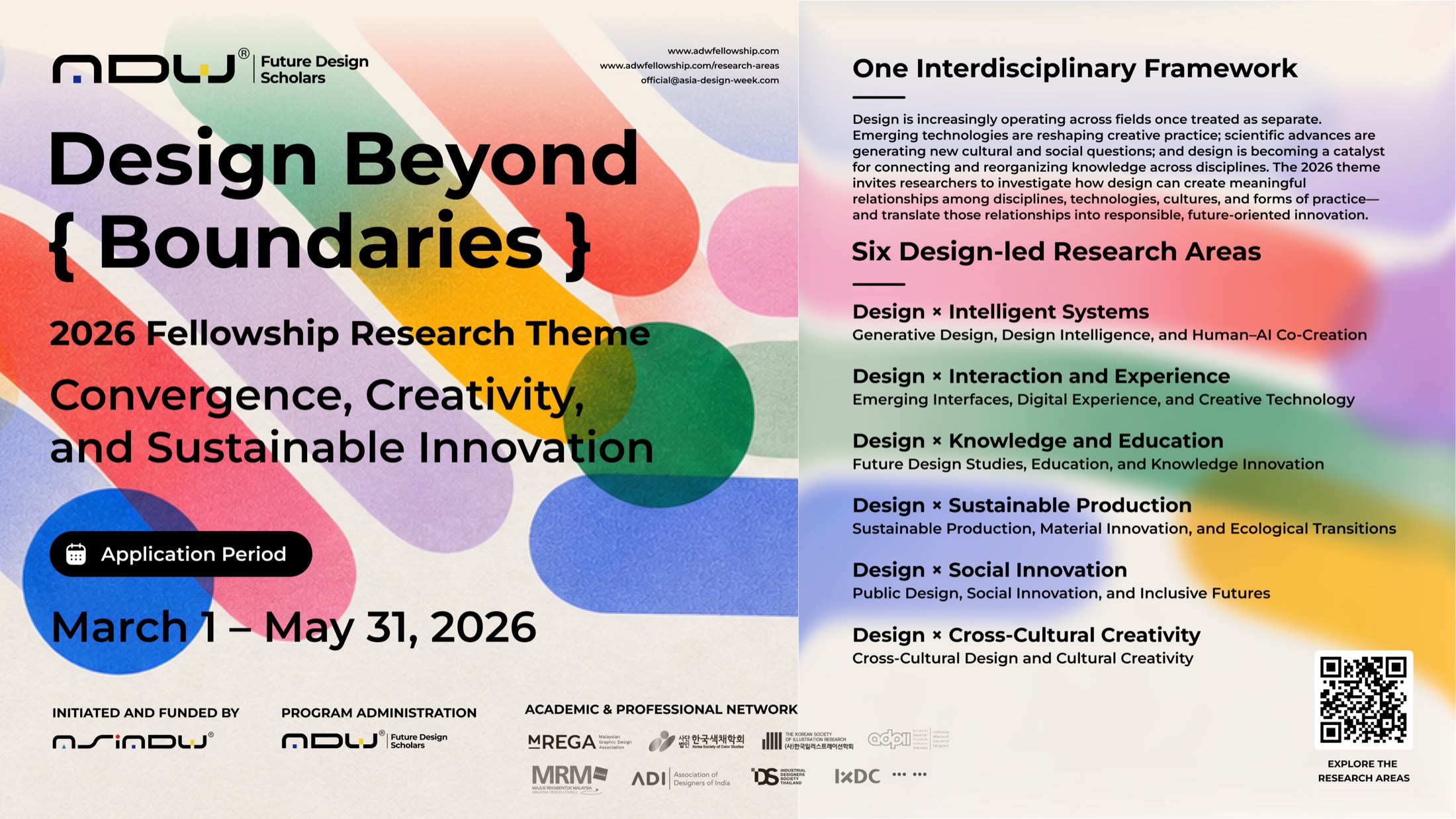
2026 Annual Research Theme
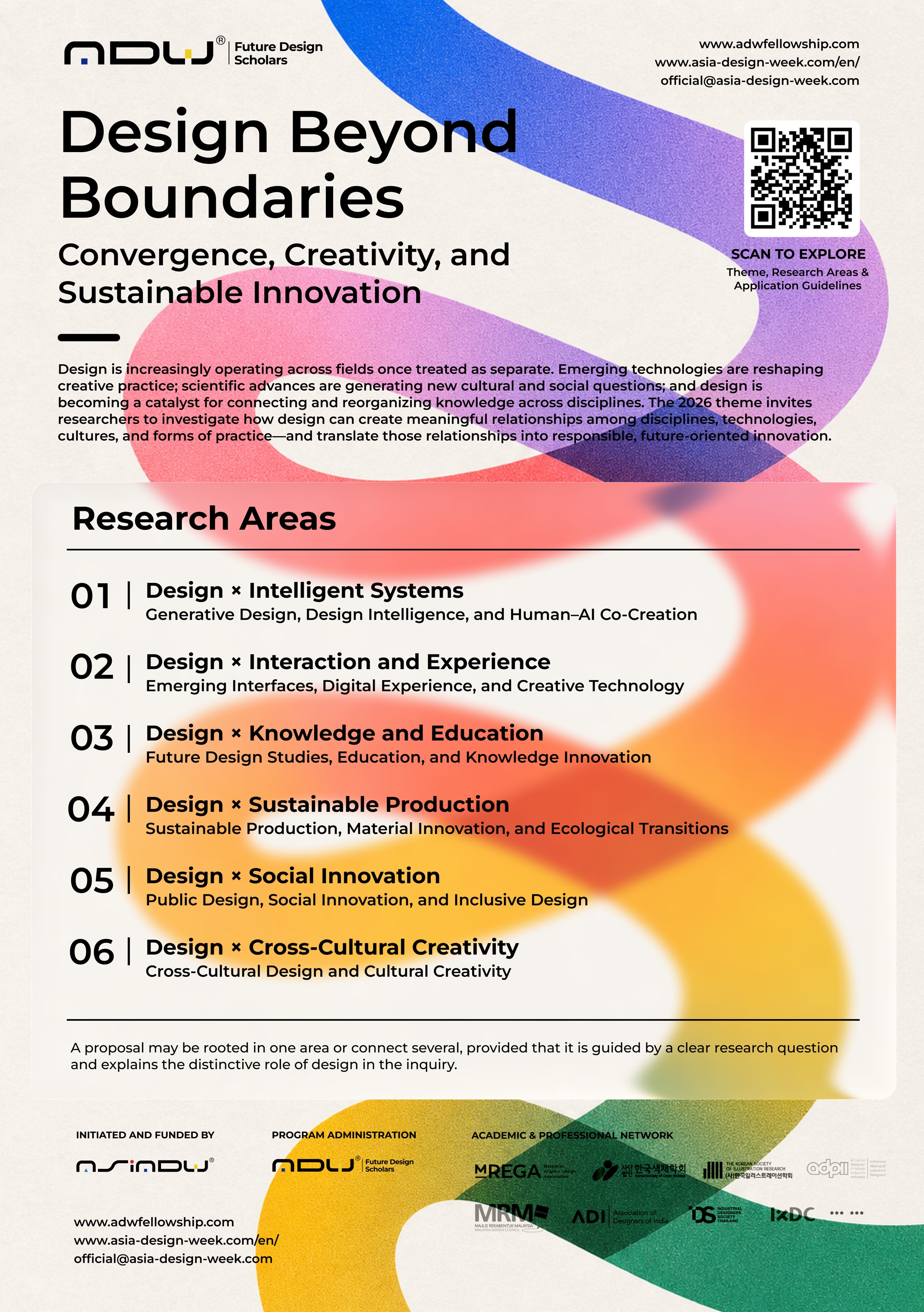
Design Beyond Boundaries: Convergence, Creativity, and Sustainable Innovation
Design is increasingly entering fields of knowledge that were once treated as separate. Emerging technologies are reshaping creative practice; scientific inquiry continues to raise new cultural and social questions; and environmental and societal challenges demand forms of knowledge-making that extend beyond any single discipline.
In this changing landscape, design may serve as a catalyst for connecting, translating, and reorganizing different knowledge systems, opening new pathways for understanding and responding to complex social questions.
Design is no longer limited to giving form, function, or expression to existing technologies, products, and systems, nor should it appear only at the final stage of interdisciplinary collaboration as a means of visualization or communication. Design is becoming a mode of inquiry that connects knowledge, organizes collaboration, and catalyzes innovation.
Moving beyond boundaries does not mean simply combining the vocabulary, technologies, or methods of different disciplines. It means using design as a connective and translational practice, one that enables previously separated knowledge, methods, and social relationships to produce new questions, new forms of collaboration, and new public value.
The theme places particular emphasis on technological transformation, cultural creativity, and social change in Asian and cross-regional contexts. Researchers are encouraged to draw upon local experience, traditional knowledge, and diverse cultural perspectives while contributing to the collective shaping of global futures.
Three Interconnected Dimensions
Convergence - Reorganizing Knowledge and Collaboration
Convergence is not the simple accumulation of outcomes from different disciplines. It involves using design to redefine problems, translate concepts, connect methods, and organize collaboration. Design can create interfaces through which scientific research, technological development, cultural understanding, social experience, and public participation work together.
Creativity - Catalyzing Imagination, Judgment, and Action
Creativity involves more than producing novel forms, products, or ideas. It concerns how people develop new capacities for imagination, judgment, and action under changing technological, cultural, and social conditions. Through speculation, narrative, prototyping, experimentation, and scenario-building, design makes possibilities visible, experiential, discussable, and testable.
Sustainable Innovation - Advancing Responsible and Enduring Transformation
Sustainable innovation is not only a response to environmental concerns; it is an ongoing judgment about the direction, institutional conditions, and long-term consequences of innovation. Design must consider not only what can be created, but what should be created, by whom, for whose benefit, and with what consequences for social, cultural, and ecological systems.
Six Design-led Research Areas
1. Generative Design, Design Intelligence, and Human-AI Co-Creation
This area examines how artificial intelligence, generative systems, and computational media participate in design reasoning, creative production, knowledge organization, and collaborative decision-making. It investigates the emerging relationships among human intention, imagination, judgment, agency, authorship, and machine capabilities.
2. Emerging Interfaces, Digital Experience, and Creative Technology
This area studies how emerging interfaces, digital environments, and creative technologies shape interaction, perception, expression, participation, and social experience. It considers how people relate to technology through bodies, spaces, objects, media, and increasingly intelligent systems.
3. Future Design Studies, Education, and Knowledge Innovation
This area revisits design as a field of knowledge, a professional practice, and a cultural force through research in design theory, history, methods, ethics, education, and futures studies. It also examines how artificial intelligence and interdisciplinary environments are changing the production, evaluation, teaching, and sharing of design knowledge.
4. Sustainable Production, Material Innovation, and Ecological Transitions
This area examines how design can reshape production systems, material practices, and technological infrastructures in response to ecological transition and long-term social change. It explores how circularity, material innovation, fabrication, and responsible production can contribute to more resilient and regenerative futures.
5. Public Design, Social Innovation, and Inclusive Futures
This area studies how design can participate in public services, social innovation, community collaboration, health and well-being, accessibility, and institutional change, while creating more equitable, participatory, and sustainable forms of public life.
6. Cross-Cultural Design and Cultural Creativity
This area investigates how design participates in the continuation, translation, and reinvention of cultural heritage, traditional knowledge, local experience, cross-cultural exchange, and contemporary creative practice, with particular attention to Asian and cross-regional contexts.
Cross-cutting Method: Research Translation and Public Knowledge
Research translation and public knowledge constitute a shared method across all six areas. The Program encourages scholars to generate, test, and communicate knowledge through prototypes, exhibitions, films, publications, archives, design systems, research tools, educational experiments, and public programs.
What We Seek
The 2026 Fellowship welcomes projects of originality, experimentation, intellectual depth, and public significance. It supports research that uses design to reinterpret questions, organize diverse forms of knowledge, build collaborative relationships, and explore possibilities that can be tested in the world.
Competitive proposals should present a clear and original research question; explain why the question cannot be adequately understood through a single discipline; define the role of design; establish a coherent and executable methodology; and articulate the project's potential contribution to knowledge, public value, and long-term impact.
Explore the research areas: www.adwfellowship.com/research-areas